


jeskli11
Oakley Beginner
Hello guys,
I would like to share my findings regarding the effects of Oakley Prizm Sport lenses on my color perception. I am mild to moderate protan colorblind, meaning I have impaired red–green color vision, more specifically reduced sensitivity of the L-cone.
The first Oakley Prizm lens I ever used was Prizm Road. I loved that lens (and still do), but after several discussions and some experimentation I realized why: it was the first time I felt I could see almost the same way a person with healthy color vision would see through a neutral-base lens.
Oakley does not state that any of its lenses are intended to correct color vision deficiencies, but from my experience rose-base lenses seem to help in my case. I have not tried EnChroma or Pilestone glasses, which—at least to my knowledge—are currently the only products explicitly marketed as color-vision-correcting.
I have tried multiple colorblindness tests, but for this experiment I stuck with the EnChroma color vision test, as it provides percentage scores for the perception of individual base colors (blue, green, red). I tested the following conditions:
Each option was tested at least three times. Below, I present the most consistent results for each lens (individual runs sometimes varied slightly, but repeated tests always converged back to the same values).
Results
Prizm Road, Prizm Trail Torch, and Prizm Low Light all increased my red-channel perception to 75 %, while Prizm Snow Sapphire boosted it all the way to 100 %.
As a side effect:
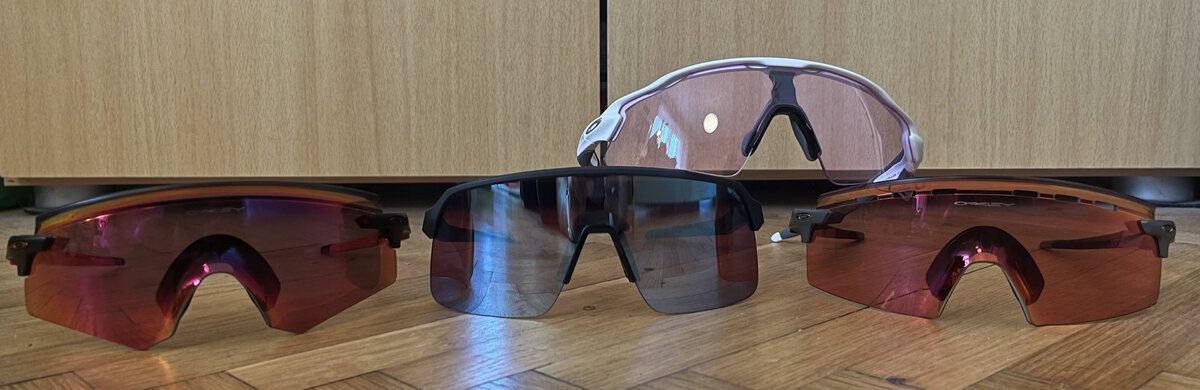
For me, experimenting with how different Prizm lenses affect my color perception as a colorblind person has been both interesting and insightful. If you have experience with Prizm lenses and color vision deficiency (especially deuteranopia), I would be very interested to hear your findings.
I would like to share my findings regarding the effects of Oakley Prizm Sport lenses on my color perception. I am mild to moderate protan colorblind, meaning I have impaired red–green color vision, more specifically reduced sensitivity of the L-cone.
The first Oakley Prizm lens I ever used was Prizm Road. I loved that lens (and still do), but after several discussions and some experimentation I realized why: it was the first time I felt I could see almost the same way a person with healthy color vision would see through a neutral-base lens.
Oakley does not state that any of its lenses are intended to correct color vision deficiencies, but from my experience rose-base lenses seem to help in my case. I have not tried EnChroma or Pilestone glasses, which—at least to my knowledge—are currently the only products explicitly marketed as color-vision-correcting.
I have tried multiple colorblindness tests, but for this experiment I stuck with the EnChroma color vision test, as it provides percentage scores for the perception of individual base colors (blue, green, red). I tested the following conditions:
- No glasses (baseline)
- Prizm Road
- Prizm Trail Torch
- Prizm Low Light
- Prizm Snow Sapphire
Each option was tested at least three times. Below, I present the most consistent results for each lens (individual runs sometimes varied slightly, but repeated tests always converged back to the same values).
Results
| Lens | Blue channel | Green channel | Red channel |
|---|---|---|---|
| Baseline (no lens) | 100 % | 75 % | 62 % |
| Prizm Road | 100 % | 75 % | 75 % |
| Prizm Trail Torch | 100 % | 62 % | 75 % |
| Prizm Low Light | 100 % | 87 % | 75 % |
| Prizm Snow Sapphire | 100 % | 12 % | 100 % |
Interpretation
As shown above, none of the lenses negatively affected my blue-channel perception.Prizm Road, Prizm Trail Torch, and Prizm Low Light all increased my red-channel perception to 75 %, while Prizm Snow Sapphire boosted it all the way to 100 %.
As a side effect:
- Prizm Trail Torch reduced green-channel perception to 62 %, which makes sense given that it suppresses green wavelengths to enhance contrast in wooded environments.
- Prizm Snow Sapphire suppressed green even more aggressively, reducing it to 12 %.
- Prizm Low Light, on the other hand, boosted my green-channel perception to 87 %.
- Prizm Road left my green perception unchanged at 75 %.
Final Thoughts
Each Prizm Sport lens has its own specific purpose and ideal use case, and none of them are designed to correct colorblindness. However, if you also have protan color vision deficiency, my experience may serve as a useful reference—keeping in mind that individual results will certainly vary.For me, experimenting with how different Prizm lenses affect my color perception as a colorblind person has been both interesting and insightful. If you have experience with Prizm lenses and color vision deficiency (especially deuteranopia), I would be very interested to hear your findings.


